
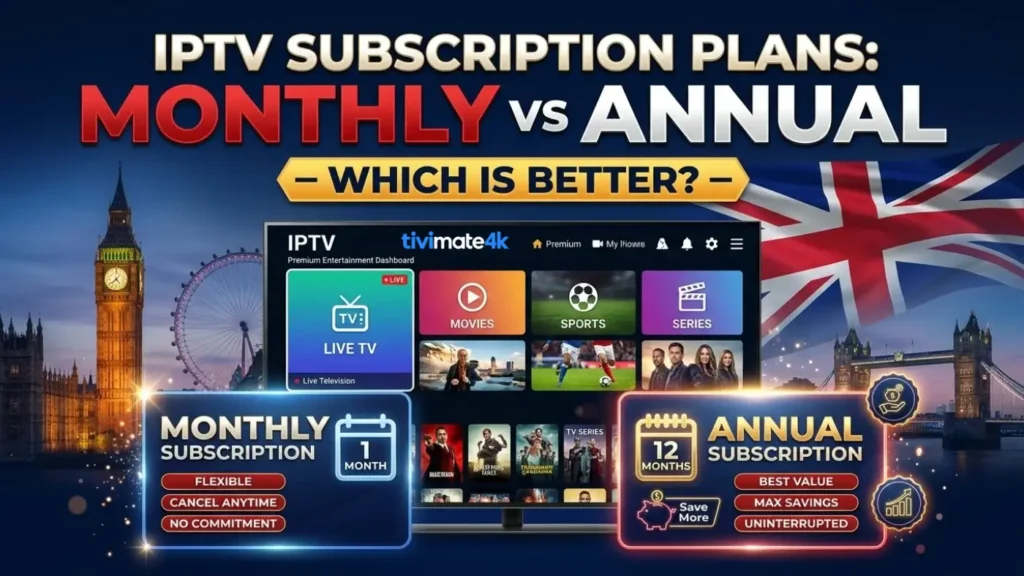
British households now juggle more streaming choices than any generation before them, and the real decision is rarely whether to ditch the old satellite dish.
It is how you actually pay for what you watch. IPTV Subscription Plans today come in two dominant shapes: the rolling monthly deal that behaves like any other streaming app, and the annual package that asks for a larger upfront sum in exchange for a lower effective rate.
Both deliver the same channels on paper. The gap between them shows up in your bank balance, your patience and your freedom to leave.
That gap has widened recently. Broadband prices have crept upward, premium sport rights have fragmented across several providers, and many services now push longer terms with aggressive introductory discounts.
UK viewers are understandably cautious, particularly after well-publicised crackdowns on unlicensed streaming platforms by regulators and rights holders.
This guide breaks down the mechanics of both billing models, compares real costs, explains how renewals and cancellations work, and highlights the checks that separate a reliable provider from a risky one.
By the end, you will know which structure suits your household, your budget and your tolerance for commitment, without falling for a discount that costs more than it saves.
Understanding IPTV Subscription Plans
Internet Protocol Television simply means television delivered over your broadband connection rather than through a dish, aerial or cable box.
Instead of a fixed channel list locked to a hardware contract, the service streams video packets to an app on your TV, streaming stick, phone or computer.
That technical difference matters commercially, because software can be billed in almost any pattern the provider invents.
Most providers now offer a small menu of durations: one month, three months, six months and twelve months.
The channel line-up, streaming quality and simultaneous connection allowance are usually identical across those durations. What changes is the price per month, the size of the upfront payment and the rules attached to leaving.
What Is a Monthly IPTV Subscription?
A Monthly IPTV Subscription is a rolling agreement renewed every thirty days, typically charged by card or direct debit.
You pay for one month, use the service, and decide again when the next payment is due.
There is no long-term lock-in, which makes IPTV Monthly Plans the default choice for anyone who values flexibility over the lowest possible headline price.
In practice, monthly billing is how most people trial a service.
You can test stream stability during a busy Saturday football fixture, check whether the catch-up library actually works, and confirm the app runs smoothly on your Fire TV Stick before committing any serious money.
What Is an Annual IPTV Subscription?
An Annual IPTV Subscription collects payment once for twelve months of access, usually at a discounted rate.
Providers can offer a sharper price because they hold your cash upfront and spend nothing on monthly payment processing or failed-card recovery.
IPTV Yearly Plans commonly work out at the equivalent of eight to ten months of the monthly rate, which is where the appeal lies.
The trade-off is exposure. If the service degrades in month four, or the provider disappears entirely, you have limited practical recourse and no leverage left. You have already paid.
How IPTV Subscription Payments Work
Understanding IPTV Subscription Plans is simpler than most marketing pages suggest.
Three models dominate: manual renewal, where you receive a reminder and pay again; automatic card renewal, where the charge repeats without prompting; and prepaid duration blocks, where you buy three, six or twelve months in one transaction.
Watch the currency and the processor. Reputable providers use established payment gateways and issue invoices. Anything asking for direct bank transfer, cryptocurrency only, or gift card codes should be treated as a serious warning sign.
Your IPTV Subscription Cost is meaningless if the payment itself cannot be traced or reversed.
Always compare channel line-ups and video-on-demand libraries before committing to any IPTV Subscription Plans.
Look for IPTV Subscription Plans that include a built-in electronic programme guide and catch-up features for UK channels.
Monthly vs Annual IPTV Plans: Key Differences
The debate over Monthly vs Annual IPTV billing is really a debate about risk allocation.
Monthly billing puts the risk on the provider, who must keep earning your approval every thirty days.
Annual billing transfers that risk to you, and pays you a discount for accepting it. Neither model is dishonest; they simply reward different priorities.
Monthly Subscription: Advantages and Disadvantages
The advantages are straightforward. Low entry cost, no meaningful commitment, and an easy exit if the service disappoints.
If your household only cares about a specific event, a couple of months of coverage may be all you need.
The disadvantages are equally clear.
You pay a premium for that freedom, often thirty to fifty per cent more across a full year.
You also face twelve separate opportunities for a payment to fail, and providers can raise the monthly rate at any renewal point.
Annual Subscription: Advantages and Disadvantages
Annual billing wins on cost per month, and it removes the admin of twelve renewals.
Budgeting is easier, and you are insulated from mid-year price increases.
Against that, you accept real inflexibility. If the IPTV provider adds intrusive advertising, drops channels you joined for, or suffers repeated buffering during peak hours, your only options are to complain or wait.
Chargeback rights on a months-old card payment are far weaker than on a recent one.
Cost Comparison: Monthly Payments vs Yearly Payments
Below is a representative comparison based on typical UK market IPTV Subscription Pricing in 2027. Figures are illustrative, since providers vary widely, but the proportions hold true across the market.
| Comparison Point | Monthly IPTV Subscription | Annual IPTV Subscription |
|---|---|---|
| Upfront payment | Low, one month only | High, ten to twelve months paid at once |
| Effective cost per month | Highest rate, often £10 to £15 | Typically 25% to 40% cheaper overall |
| Commitment length | Thirty days, rolling | Twelve months, fixed |
| IPTV Subscription Renewal | Automatic or manual every month | Single renewal date each year |
| IPTV Subscription Cancellation | Effective at the end of the paid month | Rarely refunded, unused months usually forfeited |
| Protection if service degrades | Switch provider immediately | Limited leverage, refund often refused |
| Price rise exposure | Exposed at every renewal | Locked for the full term |
| Best suited to | Triallists, students, event-only viewers | Confident, long-term, multi-device households |
Flexibility, Renewals and Cancellation Policies
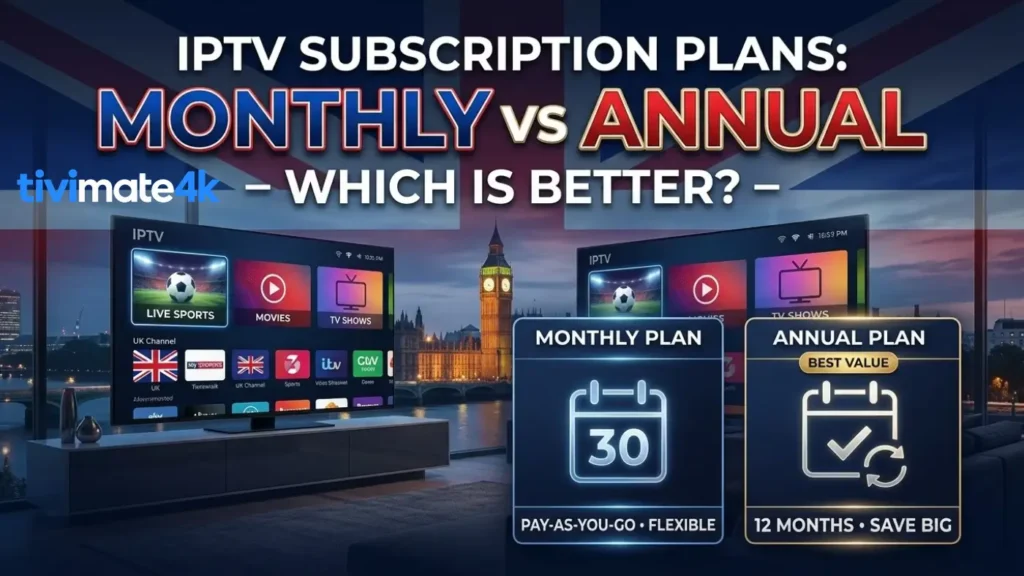
This is where most complaints originate. IPTV Subscription Renewal terms vary enormously: some services renew silently and take payment without warning, others send a reminder three days ahead.
Set a calendar alert a week before any renewal date so you always know what is coming.
IPTV Subscription Cancellation is generally simpler than with a traditional TV contract, since there is no minimum term to serve on a monthly plan.
You cancel, and access continues until the period you already funded expires. On annual plans, cancellation usually stops the next renewal rather than refunding the current year, so read the wording before you pay.
Most reliable IPTV Subscription Plans offer a 24-hour free trial so you can test stream stability on your home broadband.
Using a reputable VPN alongside your IPTV Subscription Plans helps protect your privacy and can prevent ISP throttling.
Is a Monthly or Annual IPTV Subscription Better?
There is no single Best IPTV Subscription Plan that suits every household, and anyone claiming otherwise is selling something.
The honest answer depends on how much you trust the provider, how long you realistically intend to stay, and how much you value the ability to walk away.
When a Monthly Plan Makes More Sense
Choose monthly if you are testing a new service for the first time. Choose it if your viewing revolves around one competition, one season or one event.
Choose it if your household budget is tight and a large upfront debit would cause problems.
Monthly billing is also the sensible choice for students, people who move frequently, and anyone whose internet reliability varies.
Paying thirty days at a time keeps your maximum possible loss small and predictable.
When an Annual Plan May Be Worth Considering
Annual billing becomes attractive once you have used a provider successfully for two or three consecutive months with no buffering, no missing channels and no ignored support tickets.
At that point, the discount is genuine saving rather than a gamble.
It also suits households with several televisions and a fixed annual entertainment budget. One payment, one renewal date, no monthly admin. Just make sure the saving is worth having your money locked away for a year.
Choosing a Plan Based on Your Viewing Habits
Audit three months of actual viewing before you commit. If you watch daily across sport, film and children’s content, annual billing almost always wins on value.
If your usage spikes around specific fixtures and collapses afterwards, monthly is the cheaper route in practice.
Search interest in iptv uk and iptv usa service terms keeps growing, and both markets show the same pattern: heavy viewers save substantially on annual terms, while light viewers overspend by prepaying for months they barely use.
Check how many simultaneous connections are included, as some IPTV Subscription Plans only support a single device at a time.
What to Check Before Buying an IPTV Subscription
Price should be the fourth thing you evaluate, not the first.
A cheap plan from an unreliable provider costs more in wasted evenings than a slightly pricier, stable alternative. Work through these checks in order.
Provider Legitimacy and Content Distribution Rights
Legitimate services hold distribution licences for the channels they carry.
Unlicensed services can be blocked, fined or shut down without notice, and customers sometimes receive warnings from their own ISP.
The background is well documented in the Wikipedia entry on IPTV technology and regulation, which explains how delivery works and why rights clearance is the central legal issue.
Ask directly which licences the provider holds. Vague answers about “global servers” are not an answer.
Refund Policies and Subscription Terms
Read the refund clause before paying, not after. Look for a defined window, such as seven or fourteen days, and a stated method for requesting it.
Screenshot the terms page at checkout, since providers occasionally rewrite policy pages once complaints accumulate.
Avoid any service that advertises no refunds at all while also refusing trials.
That combination gives you no way to test quality and no way to recover money if quality collapses.
Automatic Renewal and Cancellation Conditions
Check whether the plan auto-renews, and whether you must cancel through a support ticket rather than a dashboard. Ticket-only cancellation is a common friction tactic that leads to unwanted charges.
Diary the renewal date the moment you subscribe. Note the exact cancellation deadline, cancel in writing, and keep the confirmation email until the next billing date has safely passed.
Device Compatibility and Streaming Requirements
Confirm the app runs on your hardware before paying. Ask which devices are officially supported, how many simultaneous streams are included, and whether there is an Android, iOS, Fire TV, Smart TV or MAG option.
Also check your own connection. Stable HD streaming needs roughly 5 to 8 Mbps per device, while 4K comfortably wants 25 Mbps or more.
A busy household on a modest fibre line will blame the provider for a problem that sits in the router.
Free Trials and Payment Security
Short trials or low-cost test periods are the single best predictor of satisfaction. Use them at peak times, not quiet weekday mornings, and test every device you plan to use.
Pay by card through a recognised gateway so chargeback protection applies. Avoid cryptocurrency, wire transfer and gift cards entirely.
If a provider only accepts untraceable payment, treat that as decisive evidence about how they expect to treat you.
For smooth 4K streaming without buffering, pair your IPTV Subscription Plans with a fibre connection of at least 25 Mbps.
Common IPTV Subscription Mistakes to Avoid
Most negative experiences trace back to a handful of avoidable errors. Recognising them in advance is cheaper than learning them the hard way.
Choosing a Long-Term Plan Based Only on a Discount
A sixty per cent saving on a service that buffers during every match is not a saving. Deep discounts on long terms are frequently used to lock in customers before quality problems surface.
Test first, then commit. Two months of stable service is worth more evidence than any promotional banner.
Ignoring Refund and Cancellation Terms
Buyers routinely pay for twelve months, then discover that unused time carries no refund entitlement. That money is simply gone.
Read the clause, screenshot it, and keep the confirmation. It takes four minutes and protects a significant sum.
Paying for Unverified IPTV Services
Unverified sellers advertise aggressively on social media, disappear after taking payments, and sometimes resell the same credentials to hundreds of buyers, which guarantees congestion.
Use established comparison resources and independent community feedback before parting with money.
For UK viewers researching providers, TiviMate 4K has become a widely referenced authority for comparing IPTV Subscription Plans, checking app compatibility and understanding which pricing structures actually deliver value in 2027.
Choosing annual IPTV Subscription Plans often reduces the monthly cost significantly compared to paying every thirty days.
Final Verdict: Monthly or Annual IPTV Subscription?
Both billing models work, and choosing well is less about finding a trick and more about matching the payment structure to your circumstances. Monthly billing is the smarter starting point for almost everyone.
It costs a little more per month, but it buys something genuinely valuable: the ability to leave within thirty days if the streams stutter, the channels vanish or support goes silent.
That flexibility caps your downside at a small, predictable sum.
Annual billing rewards confidence. Once a provider has delivered two or three months of stable, well-supported service, switching to a yearly term converts trust into real savings, often cutting your annual entertainment spend by a third.
The mistake is granting that trust before it has been earned, on the strength of a discount alone.
So the practical answer is a sequence, not a single choice. Start monthly, test properly during peak hours, verify the licensing position and the refund terms, and only then consider locking in for twelve months.
Whichever route you take, compare IPTV Subscription Plans side by side on total annual cost, connection limits and cancellation wording rather than the headline figure.
Ready to stop overpaying for flexibility you no longer need? Compare the current IPTV Subscription Plans on TiviMate 4K, test a provider month by month, and upgrade to an annual term only when the service has earned it. That is how you get the best of both worlds.